“‘Cause I’m a little boy full of jellies and cherries
And I’ve got to save the world
And one more thing
And one more thing” (1)
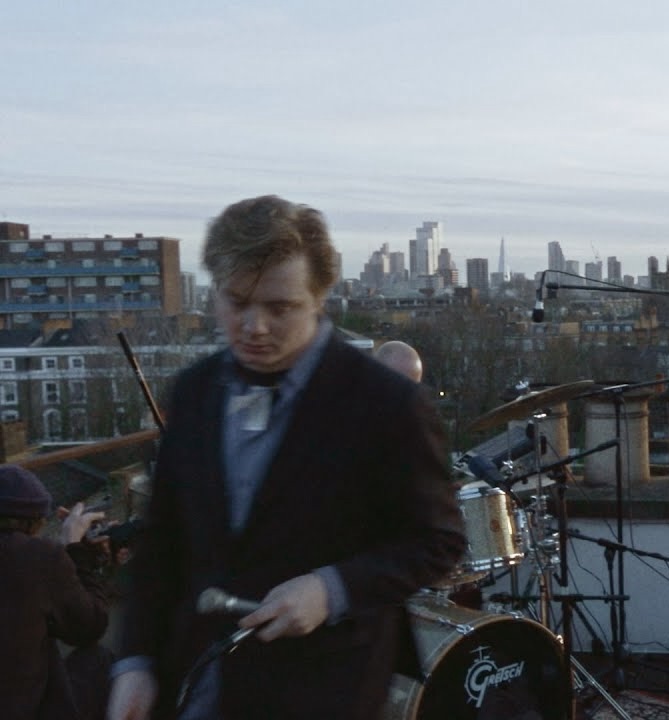
Famous are a band that have long since been in flux, a band with a shifting line-up, save the ever-present Jack Merrett. Their movement has come to an end for now – at the end of the summer, the band announced their decision to take an indefinite hiatus after nearly a decade. Following the release of three final tracks, their swan-song show was held at the ICA at the start of October.
The band made a name for themselves in South London, in the same scene as groups like black midi and Black Country, New Road. Jerskin Fendrix, who also occupied this space – now well-known for his collaborations with director Yorgos Lanthimos – was also a member of Famous for a time. I would give the routine about how fittingly ironic and un-Googleable the band’s name is, but I don’t feel it’s all that necessary.
The following is a belated write-up of my interview with the band’s lead singer and perrenial member from February this year. At the time I spoke to Jack, he was fresh – or in his own words, rather less than fresh – off the back of the band’s biggest European tour yet. While discussing the memorable cover for Party Album, Merrett – typically mordant – compared it to Blackstar. Perhaps this is notable given it was Bowie’s final album, or perhaps it was coincidence. We spoke about Party Album and its cover, nostalgia, The 1975, pop music, and Britishness.
MK: How are you, and how was the tour?
JM: I’m great. It was great thank you, the biggest one we’ve done. It felt very good, but exhausting. I’m feeling quite dead from it.
MK: With the album tour over, tell me about what you set out to do with Party Album and if you got what you expected?
JM: To make something you need to conjure within yourself a degree of optimism about what it’s going to be like, let alone how it’ll be received. You get this idea in your head and you try to make it. The thing that keeps you motivated is that you think it might be good, and that’s exciting. I’m interested in the difference between the thing you have in your head and what you actually end up making, because there’s this process of discovery that goes on each time you make a song. From the writing of it, to arrangement, to recording, mixing – all of these different stages where chance and human error – randomness – gets in there. The thing at the end – does it even resemble the notion you had going into it?
MK: Is that something that matters to you?
JM: Not necessarily. I think it’s better to be closer to the intentional side of the spectrum, rather than the purely mucking-around side. It depends on the kind of music you make, but we aimed to do something that is quite constructed and reasonably elaborate.
MK: You’ve talked about how you look to marry organic instruments with more synthetic, digital sounds. That comes across in a confronting way on Party Album. It’s very lush, but at the same time there’s that tension between these digital, crunched-out sounds and more conventional instruments. On Love Will Find A Way, we get this very clearly. Where does this come from for you?
JM: I think the perennial issue is that – I play in a band because it’s what I had imagined myself doing as a kid, but it’s a very anachronistic form. That’s part of the appeal, it brings with it this intense nostalgia for the rock band format, but when Famous was forming I was very excited about all these other genres of music. More self-consciously contemporary things, as teenagers tend to be. There has always been that tension in Famous where it is trying to justify its relevance while not quite being able to let go of this nostalgic core.
MK: On the song The Beatles you reference to Frank Ocean’s Futura Free where you say “Jerskin Slept on my sofa / Well I guess we go back that far”. This track, and Frank’s music generally, is intensely nostalgic for a lot of people; it can be quite addictive. What kind of place does nostalgia have in your work?
JM: I mean it’s all nostalgia. The whole thing is nostalgia. I’m an intensely nostalgic person. The thing I’ve been trying to work out through the writing side of things is a pretty normal instinct – to want to look back on one’s life and see significance in it, to see it as part of something, of a story worth telling. I guess it’s a kind of therapy to pour over the details of one’s life and find a lot of unpleasant emotion there, but also in recontextualising things to make them into art. And it’s not because I think that my experiences are any more important than anyone else’s. It’s just that process of taking what is a wholly unremarkable life and flipping the script to say “oh no, these events are constituent parts of a kind of universal fabric that is beautiful and worthy to be recalled and held up as an example of humanness”.
MK: You used the word “unpleasant”. Were you talking about the process of looking back and dredging up the past, or nostalgia in general?
JM: I say that because life is averagely fucked up for everyone, as my dad might say. Everyone has their share of suffering, so that is obviously part of it. There is some very personal and ridiculous stuff that I end up writing about. Largely because – you know – what else am I going to end up writing about. If you’ve got a big feeling to grapple with, you might as well lean into it and hope to at least get some closure for yourself in the process.
A very formative influence for me – and it’s an obscure one – is John Lennon. I remember being very struck by the song Mother, where he talks about his mum dying when he was very young, and him never really knowing her. Not only is it very personal, but the lyrics are very specific and could only really apply to him. “Mother you had me, I didn’t have you”. There’s nothing rational about that being something that another person can resonate with, it’s a very particular personal pain. Somehow the way he articulates it and the way he puts it to music makes it feel very universal. If you can come with the right touch and hone in on your own personal experiences to make them into something poetic, you can move people who have no frame of reference to relate to what you’ve gone through. I’m not saying for a second that’s something I’ve achieved.
MK: There’s a lot of moments on Party Album that are very specific and moving. You talking about Mother made me think of the way you say “I love you mum” on Love Will Find A Way. Why did you start the song speaking directly to your mum in this way?
JM: The first lines are just a text I’d sent my mum. I think – and I should give credit where it’s due – I stole that idea from my friend Tiernan [Banks] who plays in the band deathcrash. I think he has some lyrics which were a text to his mum that were much more moving than mine. I liked that idea, and then there was this quite banal message I’d sent my mum which went something like
“Love you mum
I got vaccinated on Saturday
Felt fine”
I find heavy handed politics in music to not really be to my taste, so there was something quite funny to me about this extremely bait, mainstream political take that vaccines are fine. Putting that in a song seemed quite amusing to me –
MK: Especially in a song like that.
JM: Yeah! It was a funny kind of public health announcement. That song was written uncharacteristically quickly for me. It all came out at once, so it’s hard to unpick exactly what I was going for. But I think, as I’ve thought about it more, I was just playing with some different registers in which to talk about love; putting them jarringly in the same space. That very domestic, homely love that you have with a parent as a young adult. Then there’s my slightly more unrealistic and tragic sense of romantic love in there as well.
MK: That’s quite pervasive for you?
JM: Yes – unfortunately! And then – again – I thought it was quite funny. That “love will find a way bit” – it was very early in the album-writing process and I had this silly idea that the whole album would be a grand allegory of Christian love, but in a summer of love / All You Need Is Love kind of way. Nobody does that anymore.
MK: It feels like love on a lot of the album has a very strong ‘you’ and a very strong ‘I’ – but misses much cohesion, at least until Leaving Tottenham. The lines “You really believe me / You people don’t leave me” begin to look past doubt, to a moment of realisation that “oh, maybe this is okay, maybe I’m safe here”. And then you end it all with a loud, triumphant song that interpolates Wagner. It cracked me up. It seems sweet, but definitely bit tongue-in-cheek.
JM: I think this shows that I don’t really know where I’m landing on any of it. It’s common when I talk to people about the album that I’m given credit for this sense of narrative which was accidental, actually. The song was gonna be the first track [on Party Album] at one point.
I think it’s astute that you say there’s loads of me. It’s not really what I want, but I think it’s true. It reflects the kind of experiences I am talking about, ones that put you in your own head a lot. There’s a sense of being slightly trapped there.
MK: Let’s talk about something else. It made me laugh when I read over an old interview of yours and you were discussing how much you loved The 1975. You took your mate to a show and he hated it. Do you still have a soft spot for them?
JM: At least myself and Lyle [Burton], the drummer, are big fans. I would say they’re my favourite band who are still putting stuff out. They’re kind of hard to argue with in a way. I get why they wind people up, but they’re so good as a band, as a live unit, and the scale on which they’re operating is so much bigger.
All my heroes – Elvis, The Beatles, Prince – the people I really refer back to, operated on a scale that is so epic. I don’t think many bands – if any – are playing in the same arena today. I wouldn’t make any grand claims about the quality of The 1975’s music, but that ambition, that attempt to connect with a really big public…what I feel that people miss about them is that what they do is so much harder than just being cool. To make music that is interesting – which I think theirs is – but still connect with a vast number people is so difficult.
MK: It’s so hard to write a banger and also have that banger not be a bit of a piece of shit.
JM: More than it being a banger – though – I always think “what does it take?” There are some songs that are really successful in North America and Europe – maybe Japan, but there are some songs that have hundreds of millions of plays in Jakarta every month. The Arctic Monkeys get to go on tour in the Philippines, Ed Sheeran and Coldplay do these massive tours in India where they play some of the biggest crowds of all time. There’s some kind of possibility for mad global connection that I find really interesting. Whether you like it or not, there is something that these artists can tap into that is so universal and resonant.
I spent quite a lot of my childhood in the part of Suffolk that Ed Sheeran is from. It couldn’t be more of a random part of the world. You know, he’s not especially good looking, not the best singer, but he’s just got something. I do find it very fascinating about what exactly it is that these people do to resonate that kind of scale. It’s lazy to just go “that’s easy” or “it’s lame”. That attitude is so uncurious.
MK: Yeah, there is something to whatever the hell Chris Martin is doing. Even if it seems obvious, it’s so easy, and a bit pretentious, to look down on that.
JM: I guess the point I’m making is that they might be shit. But I don’t think that’s the most interesting thing about them. There’s loads of people making shit pop music, why are they the ones who have this unimaginable celebrity? Is it just chance? That doesn’t seem very likely. It’s a worthwhile thing for musicians to consider, just as listening to obscure, experimental is. It’s all interesting.

MK: I wanted to talk to you a little bit about the album cover, because I think it’s striking. Where did it come from?
JM: The idea originally came from a conversation I had with my manager where I was thinking about the Blackstar, the end of career album kind of thing. So I just went “the union jack is the cover – fuck it”. Maybe it’s because he’s French and doesn’t quite get how contentious that might be, he was like – “just do it man, it’ll be cool”. I ummed and ahhed about it, but we haven’t had much pushback.
MK: I think it just made me laugh, the Union Jack typeface. Britishness is such a contentious thing at the moment, and something that I feel quite uncomfortable with as a British person. How you treat ‘Britain’ and ‘England’ is reminiscent to me of how Isaac Wood did in his work with Black Country, New Road. You might have been told that by people that don’t have much musical insight like myself. Vulnerable but highly referential and concerned to a certain extent with what the fuck it is to be in Britain.
JM: I’d be flattered – he’s a very talented guy. I guess that [fixation with Britishness] comes back to this nostalgia thing, this desire that feels fairly normal and universally human to narrativise oneself – even if you don’t express it like that. Who you are, where you come from, what that means. It’s a funny thing and it feels slightly vexed and complicated to do that in British contexts – for good reasons. However, it leaves those of us who have the indignity of being British in a position where it’s quite tough to know who you are and what you’re meant to feel about the culture that you come from.
I found it quite fun to play with. On the specific question of the flag, it is a mixture of being tongue-in-cheek. If there is anything there, I think it’s a sense that ideas and symbols of the nation are the reserve of stridently right-wing politics, and I believe that’s a real mistake. I think it’s important that people who have a positive and progressive view of what the nation might be in the future take ownership of those symbols. I think that’s a good thing to do politically.
I think that slightly mystical, slightly fantastical idea of Britain I try and write about – a place of paradox, folklore and odd, fragmentary history – is a fairly benign view of Britain that people can feel a general sense of participation in. It’s good to espouse that as an alternative to people who stand up and say that flag just means imperialism, that flag means racism. Because it means what you want it to mean. I am deciding on this for today, that it means something silly, and deeply romantic.
(1) Revelation is one of latest – and for now, the last – three songs by Famous.
 maxim knowles
Leave a comment